1. Basic Concepts
1.1 ICAP
Amazon ICAP is a funnel-style framework used in Amazon Advertising and retail analytics to understand how shoppers move from seeing a product to buying it. It breaks customer behavior into four measurable stages: Impression, Click, Add to Cart, and Purchase.
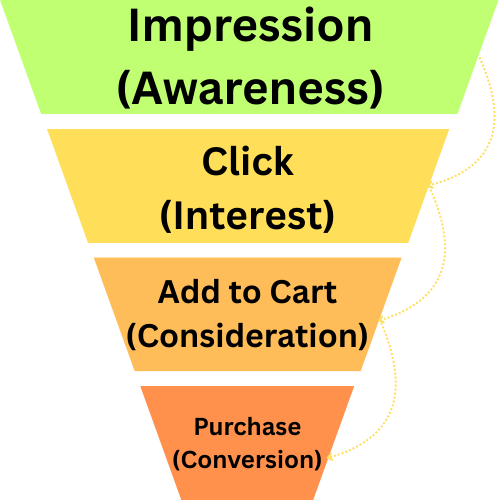
- IMPRESSION: An impression occurs when the product ad or listing is shown to a shopper on Amazon.
- CLICK: A click happens when a shopper interacts with the product ad or listing after seeing it.
- ADD TO CART: An Add to Cart occurs when a shopper adds the product to their cart, indicating strong purchase intent, even if they don’t buy immediately.
- PURCHASE: A purchase is the final conversion––the shopper completes the order.
1.2 A10, COSMO & Rufus
The Amazon A10 algorithm is the core ranking system that determines how products appear in Amazon search results. Its primary goal is to surface products that are both relevant and valuable to shoppers, based largely on performance signals rather than pure relevance alone. A10 evaluates products through a wide range of metrics, including organic sales, click-through rate, conversion rate, PPC-driven sales, 180-day sales history, off-site traffic, reviews, sales velocity, impressions, and seller authority. Together, these signals help Amazon decide which products deserve greater visibility in search rankings.
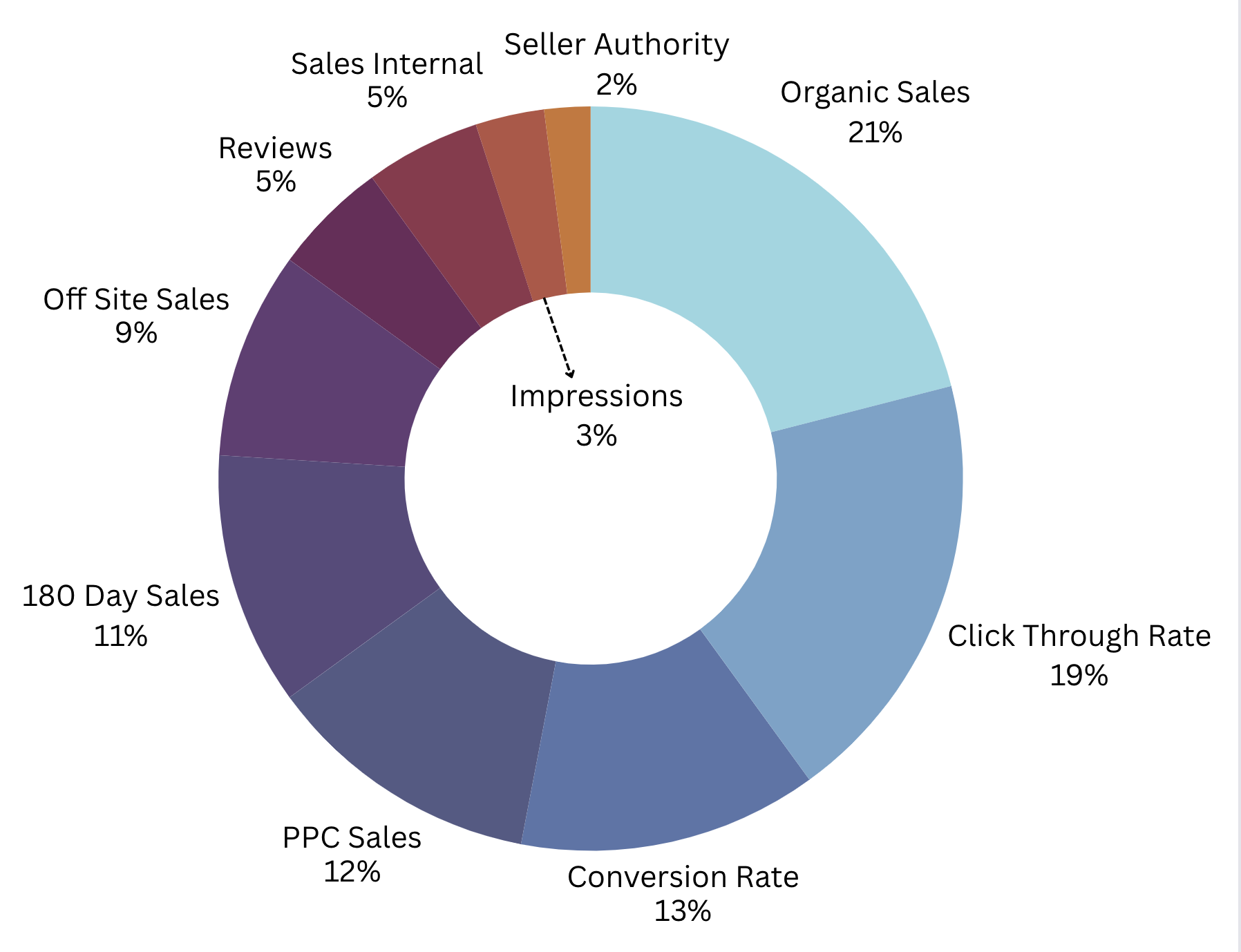
Despite its effectiveness, A10 has a critical limitation: semantic blindness. The algorithm relies heavily on exact-match or phrase-match keywords and lacks true contextual understanding. For example, if a shopper searches for “winter hiking gear”, A10 may fail to surface a “windbreaker” unless the word “hiking” explicitly appears in the product’s metadata. A10 does not inherently understand that a windbreaker is commonly used for hiking unless it is directly told so through keywords. This limitation has historically encouraged the practice of keyword stuffing, where sellers force unrelated or loosely related keywords into listings in an attempt to gain visibility.
To address this gap, Amazon developed COSMO, which stands for Customer, Object, Semantic, Matching, and Optimization. COSMO is an internal relevance and matching system that operates alongside the A10-style ranking framework. Unlike A10, COSMO focuses on interpreting what the shopper means, not just what they type. It aligns user intent with ads, ASINs, keywords, categories, and brands, enabling more accurate and meaningful matches.
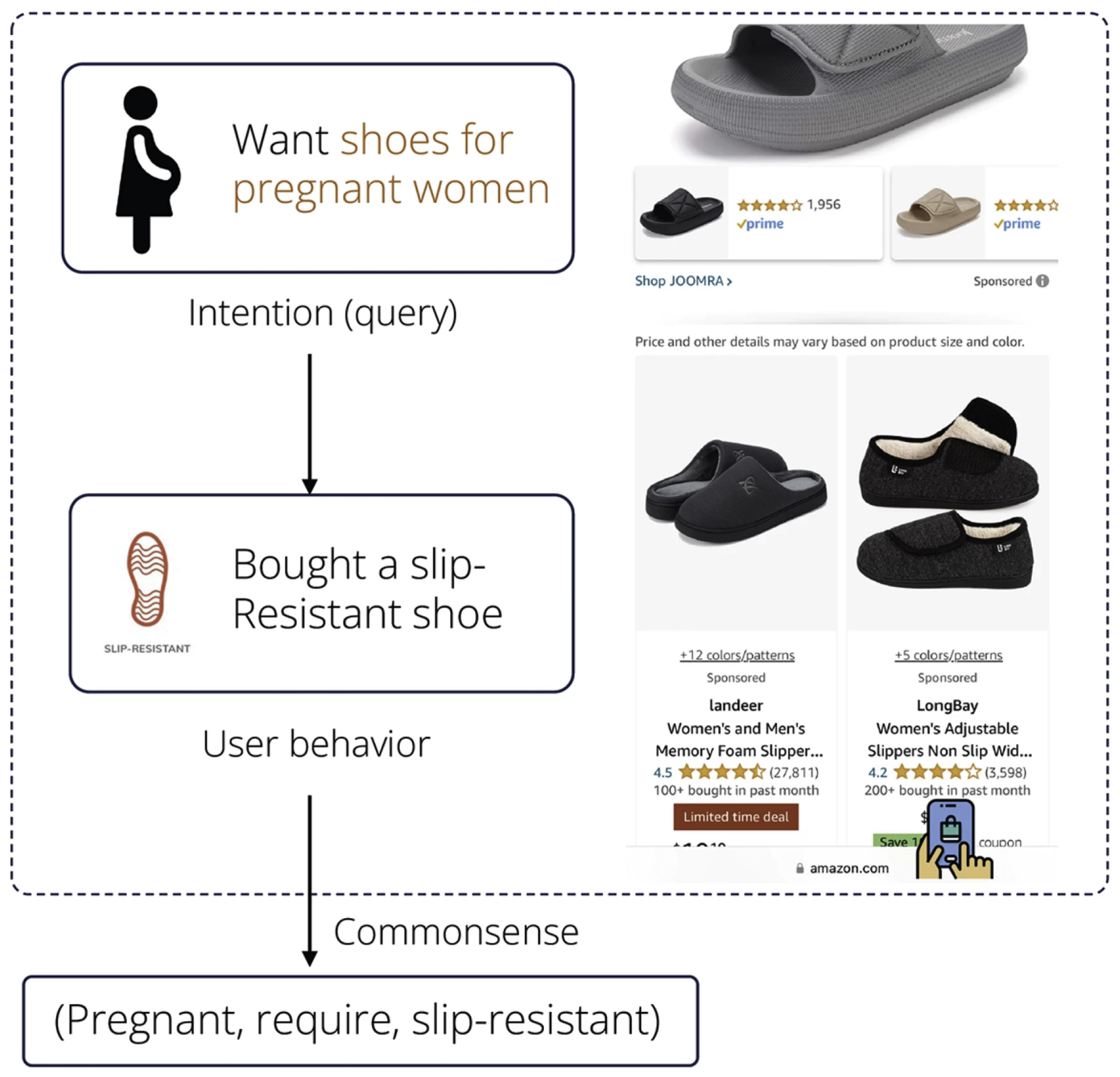
COSMO operates through a recursive, AI-driven process. Large Language Models (LLMs) generate hypotheses about commonsense relationships using massive datasets such as query-to-purchase and co-purchase behavior. These hypotheses are filtered through a combination of machine learning models and human annotation. HUman reviewers then extract high-quality guiding priciples, which are transformed into structured instructions that further train and prompt the LLMs. This human-in-the-loop design ensures both scalability and accuracy.
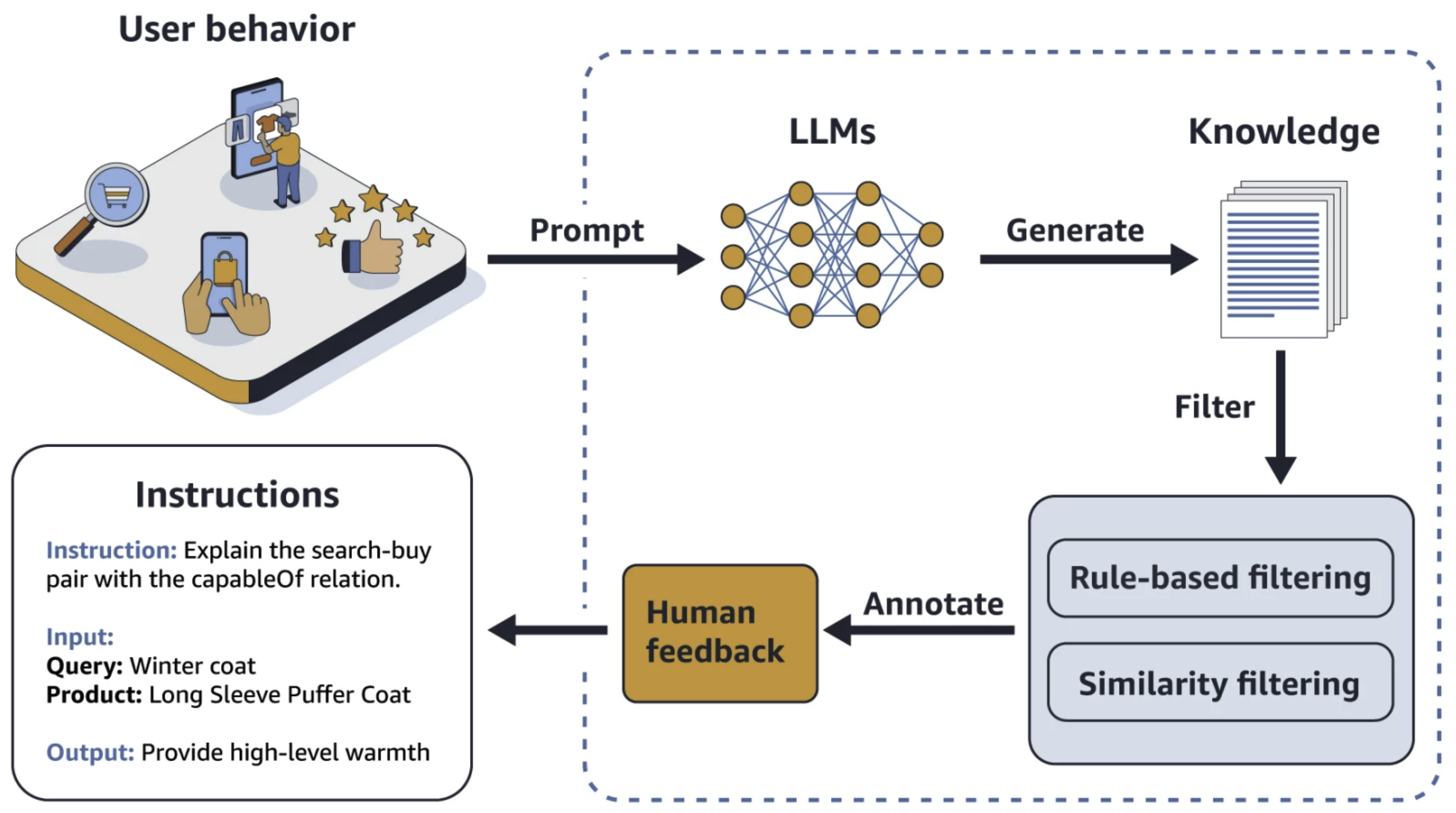
Fundamentally, COSMO differs from A10 in how it structures information. While A10 indexes strings of text, COSMO builds a Knowledge Graph––a large scale network of entities and relationships that connects products to real-world contexts, human behavior, and abstract concepts. By leveraging LLMs trained on billions of user interactions, browsing sessions, and purchase behaviors, COSMO uncovers latent relationships between products and user goals that are never explicitly written in listings.
This difference is best illustrated through an example. When a user searches for “camping supplies,” A10 simply scans for products containing that exact phrase. COSMO, however, understands the broader concept of camping. By referencing its knowledge graph, it recognizes that items like mosquito repellent or portable stoves are commonly associated with camping. As a result, COSMO can surface these products even if the seller never used the word “camping” in the product listing.
This represents a fundamental shift from keyword matching to intent matching. COSMO organizes information into hierarchical structures that allow for “multi-turn navigation.” A broad query such as “hiking” can progressively refined into “windbreaker”, and then further into attributes like “waterproof” or “reflective,” based on inferred user intent and behavioral signals.
Building on this intelligence, Rufus serves as the consumer-facing application of Amazon’s AI ecosystem. Rufus is a generative AI assistant trained on Amazon’s product catalog, customer reviews, community Q&A content, and authoritative external sources. It allows shoppers to interact with Amazon’s data conversationally rather than through keywords alone.
Rufus operates using a Retrieval-Augmented Generation (RAG) framework. When a user asks a question, Rufus retrieves relevant documents––such as product descriptions, specifications, and reviews––and then uses an LLM to generate a natural-language response. Importantly, research shows that Rufus prioritizes verified customer reviews and Q&A content over seller-provided descriptions when discrepancies arise. In Amazon’s AI hierarchy, the “voice of the customer” is treated as the most reliable source of truth.
| Feature | A10 Algorithm | COSMO (AI Graph) | Rufus (AI Assistant) |
|---|---|---|---|
| Core Logic | Lexical Matching (Keywords) | Semantic Matching (Intent) | Generative AI (RAG) |
| Primary Data Source | Title, Bullets, Backend Terms | Knowledge Graph, User Behaviour | Reviews, Listing Text, Web |
| User Input | Keywords (e.g., running shoes) | Concepts (e.g., marathon training) | Questions (e.g., Are these good for flat feet?) |
| Output | Ranked Product Grid | Refined / Personalised Recommendations | Conversational Answers |
| Optimization Goal | Indexing & Velocity | Categorization & Context | Accuracy & Sentiment |
2 A10-COSMO-Rufus Based Listing Optimization
2.1 Title
With the evolution of Amazon’s search and AI systems, the product title still remains the strongest signal for the A10 ranking mechanism, but its role has expanded. Today, a title must serve a dual purpose: it needs to maintain sufficient keyword density to satisfy traditional ranking logic, while also being naturally readable and semantically clear for AI-driven systems such as COSMO and Rufus. Titles that are optimized only for keywords risk losing meaning, while titles written only for humans may fail to rank.
Modern AI models no longer interpret titles as isolated keywords. Instead, Rufus parses product titles into structured Noun Phrases, such as “ergonomic lumbar support,” rather than treating each word independently. In addition, it identifies subjective attributes that commonly appear in user queries, including descriptors like “comfortable”, “durable,” or “sturdy.” As a result, optimization must move away from the traditional “keyword salad” approach and toward clear, descriptive sentences that express product value in a natural way.
This shift can be clearly seen when comparing legacy and AI-optimized title structures. A traditional keyword-stuffed title might read:
“Water Bottle, Gym Bottle, Leakproof, Blue, 32oz, Running, Sports, BPA Free, Men, Women, Kids.”
In contrast, an AI-optimized title would read:
Leakproof 32oz Sports Water Bottle for Gym and Running – Durable Blue Plastic with Ergonomic Grip and BPA Free Material.
The AI-optimized version does more than improve readbility. It establishes explicit semantic relationships that COSMO can accurately map into its knowledge graph. For example, it defines how the product is used (usedFor: Gym, Running), what attributes it has (hasAttribute: Leakproof, Durable, BPA Free), and what it is made of (isMaterial: Plastic). By using prepositions such as “for” and “with,” along with proper sentence structure, the seller clearly communicates how each attribute relates to the product.
This explicit structure reduces the computational effort required for AI systems to infer meaning, allowing COSMO to categorize the product more accurately and Rufus to describe it more confidently to shoppers. In practice, well-structured, descriptive titles now function as both a ranking signal and a semantic blueprint for Amazon’s AI-driven discovery ecosystem.
2.2 Bullet Points
Rufus actively scans bullet points to extract answers to shopper questions. When a user asks something like “Is this safe for dishwashers?”, Rufus does not infer the answer on its own; instead, it looks for clear semantic equivalents of “yes” or “no” within the bullet content. If the bullets do not explicitly confirm or deny the condition, Rufus may respond with uncertainty or omit the product from its recommendations.
For this reason, bullet points should be written to preemptively answer the most common customer questions in the category. the most reliable source for identifying these questions is the “Customer Questions & Answers” section on competing listings. By aligning bullet content with these recurring concerns, sellers increase the likelihood that Rufus can confidently surface accurate answers during conversational queries.
To support AI readability, bullet points should follow a clear structural blueprint. Each bullet should begin with a benefit-driven header (for example, “Dishwasher Safe Design”), followed by a natural-language explanation that connects the feature directly to a user benefit. This structure mirrors how shoppers think and how AI systems parse meaning.
For example, a well-optimized bullet might read: “Cleaning is effortless as this bottle is fully dishwasher safe on the top rack, resisting warping even at high temperatures.” This complete sentence provides the contextual detail Rufus needs to confidently answer a dishwasher––safety question in the affirmative. In contrast, fragmented phrases such as “Dishwasher safe. Heat resistant.” lack sufficient context, making it more difficult for large language models to interpret condtions, limitations, or confidence levels accurately.
2.3 Search Terms
Despite the rapid evolution of Amazon’s AI-driven discovery systems, backend search terms continue to play an important––though clearly limited––role. Their primary function is to supply the A10 algorithm with synonyms, alternative spellings, and edge-case keywords that do not fit naturally into customer-facing content such as titles or bullet points. Backend terms are not visible to shoppers and do not contribute to semantic understanding for COSMO or Rufus, but they can still improve indexing coverage at the lexical level.
Amazon enforces a strict 250-byte limit (not characters) on backend search terms. This limit is evaluated as a binary pass/fail check. If the field exceeds 250 bytes, none of the keywords are indexed at all––Amazon does not index the first 250 bytes and ignore the remainder. As a result, precision and byte efficiency are critical when populating this field.
An effective optimization protocol begins with eliminating stop words such as “a,” “and,” “for,” or “with.” These words consume valuable bytes but are ignored by the algorithm. Punctuation should also be removed, as commas, periods, and semicolons waste byte space; single spaces are sufficient to separate terms. In addition, keywords should never be repeated if they already appear in the title or bullet points, since backend terms are intended only for incremental coverage, not reinforcement.
The highest return on investment comes from prioritizing true sysnonyms and regional or colloquial variations. Examples include using “gym container” instead of “water bottle,” or “skipping rope: instead of “jump rope.” These variations expand reach without competing with existing indexed terms.
From a Rufus alignment perspective, conversational phrases and full questions are better placed in visible content where context matters. Backend terms may store limited variations if space allows, but in most cases, single-word synonyms deliver far greater value per byte.
2.4 Product Attributes
Amazon’s backend attribute fields—such as Material Type, Pattern, Wattage, and Intended Use—play a critical role in how products are interpreted and filtered by COSMO’s semantic matching system. These structured fields are not merely supplementary metadata; they feed directly into COSMO’s filtering and refinement logic, especially during advanced or intent-driven search journeys.
When shoppers progressively narrow a search using specific criteria, COSMO relies on these attributes to support multi-turn navigation, where a broad query is refined step by step into more precise requirements. If these backend attributes are left blank or incomplete, COSMO has no reliable signal to confirm whether a product meets the refined conditions. As a result, the product is excluded from these filtered results—even if it is otherwise highly relevant.
From COSMO’s perspective, missing attribute data effectively renders a product invisible in refined searches. In an ecosystem increasingly driven by semantic understanding and intent matching, maintaining a complete and accurate set of backend attributes is essential to ensure that products remain discoverable throughout the entire customer decision journey, not just at the initial search stage.
2.5 Product Images
One of the most significant advances in the Rufus engine is its deep integration with Computer Vision and Optical Character Recognition (OCR). Rufus no longer treats product images as static visual assets or binary files. Instead, it actively reads pixels to extract semantic meaning, identifies objects within images, and interprets any text embeded in them. This shift fundamentally transforms product images from passive conversion tools into active data sources that directly contribute to how products are understood, indexed, and explained by AI.
Historically, text overlays and infographics on product images were created purely for human shoppers––to highlight key features quickly as users scrolled. Today, Rufus uses OCR to scrape and interpret this text in order to answer user queries and infer product capabilities. Research confirms that Rufus can extract structured information from images, such as ingredients listed on a supplement label or dimensions shown in a technical diagram. As a result, the informational accuracy of image text now carries algorithmic weight, not just visual appeal.
To support reliable AI interpretation, product images must meet specific design requirements for AI readability. Text overlays should use large font sizes to remain legible both to mobile users and to OCR systems, which can struggle with small or low-resolution text. High contrast between text and background is essential for accurate extraction, and sans-serif fonts are preferred due to their clean lines and lower OCR error rates. Just as importantly, data consistency is critical: any text shown in images must exactly match the information in bullet points and other listing content. Conflcting data––such as an image stating “10-hour battery life” while the bullets claim “12 hours––creates hallucination risks for Rufus, refucing confidence and potentially suppressing AI-generated answers altogether.
During the 2024–2025 period, Amazon also made a critical shift by deprecating Alt Text as a direct ranking signal for the A10 algorithm. In the past, sellers frequently stuffed keywords into image Alt Text to influence rankings. Amazon has since moved away from trusting seller-supplied Alt Text for internal ranking, choosing instead to rely on its own computer vision systems, such as Amazon Rekognition, to automatically tag and classify images.
This change requires a strategic pivot toward Visual Semantics. Rather than relying on invisible metadata, the image itself must clearly depict the intended concept so AI systems can classify it correctly. For example, to surface for “running gear,” a lifestyle image should unmistakably show a person running—using cues like athletic posture, motion blur, and a road or track environment. Ambiguous imagery risks being misclassified, which can reduce visibility in COSMO’s intent-based filtering and recommendation flows.
That said, Alt Text is not entirely obsolete. While its influence on Amazon’s internal ranking has diminished, it remains important for accessibility compliance and for Google’s indexing of Amazon product pages, which can indirectly drive external traffic. Sellers should therefore maintain accurate, descriptive Alt Text without relying on it as a keyword-ranking lever.
Ultimately, modern infographics must now serve two masters: the rapid skimmability required by mobile shoppers and the structured data extraction required by Rufus. Effective optimization relies on clean, structured layouts, using clear headers and simple bullet-style groupings within the image. AI vision models are trained on document understanding, so structured designs are far easier to parse than cluttered collages of text bubbles. Given that over 70% of traffic comes from mobile devices, infographics should prioritize fewer, bolder points per image, avoiding dense “walls of text” that degrade both human readability and AI comprehension.
2.6 Q&A
The Customer Questions & Answers section is frequently underestimated, yet it is one of the most valuable areas for Rufus optimization. This section provides structured, verified conversational data that Rufus can directly reference when responding to shopper queries. Sellers should actively encourage legitimate questions—either organically from customers or, where appropriate, through friends or family—that reflect long-tail keywords and specific real-world use cases, such as “Can this blender crush ice for smoothies?”
Equally important is how these questions are answered. Sellers should respond promptly and in complete, descriptive sentences that clearly restate the question’s key terms. A minimal response like “Yes, it can” provides little semantic value and is difficult for AI systems to interpret with confidence. In contrast, an optimized response such as, “Yes, this blender is designed with a high-torque motor specifically to crush ice for smoothies effectively,” explicitly confirms the capability while reinforcing the relevant keywords and context.
Rufus indexes these question-and-answer pairs as verified sources of truth. When a shopper later asks Rufus a similar question, the system can pull a direct, authoritative answer from this Q&A content. This significantly increases both the confidence of Rufus’s response and the likelihood that the product will be recommended in conversational search results.
2.7 A+
Enhanced Brand Content (A+) has evolved from a competitive advantage into a baseline expectation for brand-registered sellers on Amazon. Listings without A+ content now appear incomplete and less trustworthy, which can negatively impact both conversion performance and overall competitiveness within the category.
For brands that are eligible, Premium A+ further expands these capabilities by offering interactive modules such as carousels, looping videos, and hotspot images. These interactive elements encourage shoppers to spend more time engaging with the product detail page, increasing dwell time—a behavioral signal that is positively correlated with stronger performance under the A10 ranking algorithm.
Among all A+ modules, the comparison chart consistently delivers the highest conversion rate optimization (CRO) impact. It allows sellers to showcase and cross-sell products within their own catalog while guiding shoppers toward the most appropriate option. Just as importantly, an effective comparison chart helps prevent users from exiting the page to click on Sponsored Products ads from competitors, keeping attention and purchase intent within the brand ecosystem.
3. Listing Specifications
3.1 Title
- Title Structure: [Brand] + [Primary Keyword] + [Key Feature] + [Use Case] + [Size/Specs]
- CAMTOP Kids Lunch Box Insulated Lunch Bag for school, camping, picnic
- Title Optimization Mistakes
- ALL CAPS TITLES: Amazon’s TOS violation, can get suppressed
- Promotional language: “Best,” “Top Rated,” “Sale” not allowed in titles
- Keyword stuffing: “Yoga mat yoga mat for yoga” kills readability, doesn’t help ranking
- Irrelevant keywords: Adding “for men women kids” to every listing dilutes relevance
3.2 Bullet Points
3.3 Search Terms
3.4 Product Description
3.5 Keyword Targeting Framework
- Primary keywords (3-5 total): High search volume, high relevance, goes in title and bullets
- Secondary keywords (10-15 total): Medium volume, goes in bullets, description, backend
- Long-tail keywords (20-30 total): Low volume but high conversion, backend search terms only
3.3.1 Key Takeaway
- Search Terms are low-risk and flexible, allowing frequent testing and optimization.
- Search Terms are ideal for:
- Synonyms and alternate phrasing
- Misspellings and reginal spellings
- Abbreviations and acronyms
- Seasonal, event-based, or intent-driven terms
- Rusult-based searches (e.g., “fat loss” for herbal tea, within policy)
- Best practices for search terms:
- Use relevant, natural, buyer-style phrases.
- Avoid redundency with front-end content (title, bullet points, and product description.)
- Use lowercase, separated with single spaces, no punctuation, articles, and prepositions.
- Prioritize high-intent, low-competetion, and long-tail keywords.
- Common reasons keywords don’t get indexed:
- Duplicate keywords already used in title or bullets
- Exceeding the 250-byte limit
- Use of prohibited, irrelevant, or trademarked terms
- awkward, unatural phrasing
- Special characters or punctuation
- PPC synergy: adding PPC-converting keywords to backend fields strengthens relevance signals and reduces reliance on paid ads alone.
- Indexing checks can be done manually (f”{keyword} {ASIN}”). If indexing fails, debug backend fields by removing suspicious keywords and rechecking after 24-48 hours.
- Search Term Reports (STR) are crucial for finding:
- Hidden winning keywords
- Long-tail variations
- Seasonal trends
- Semantic and reginal variations
- High-impression, low-CTR opportunities
- Do’s & Don’ts:
- Use all 250 bytes strategically
- Focus on relevance and buyer intent
- Include backend-only variants
- Match natural search order
- Localize for different marketplaces
- Don’t reuse front-end keywords
- Don’t keyword stuff or over repeat variations
- Don’t use competitor brand names
- Dont’ add misleading or irrelevant terms